
Exodus
On leaving the U.S.A for Europe

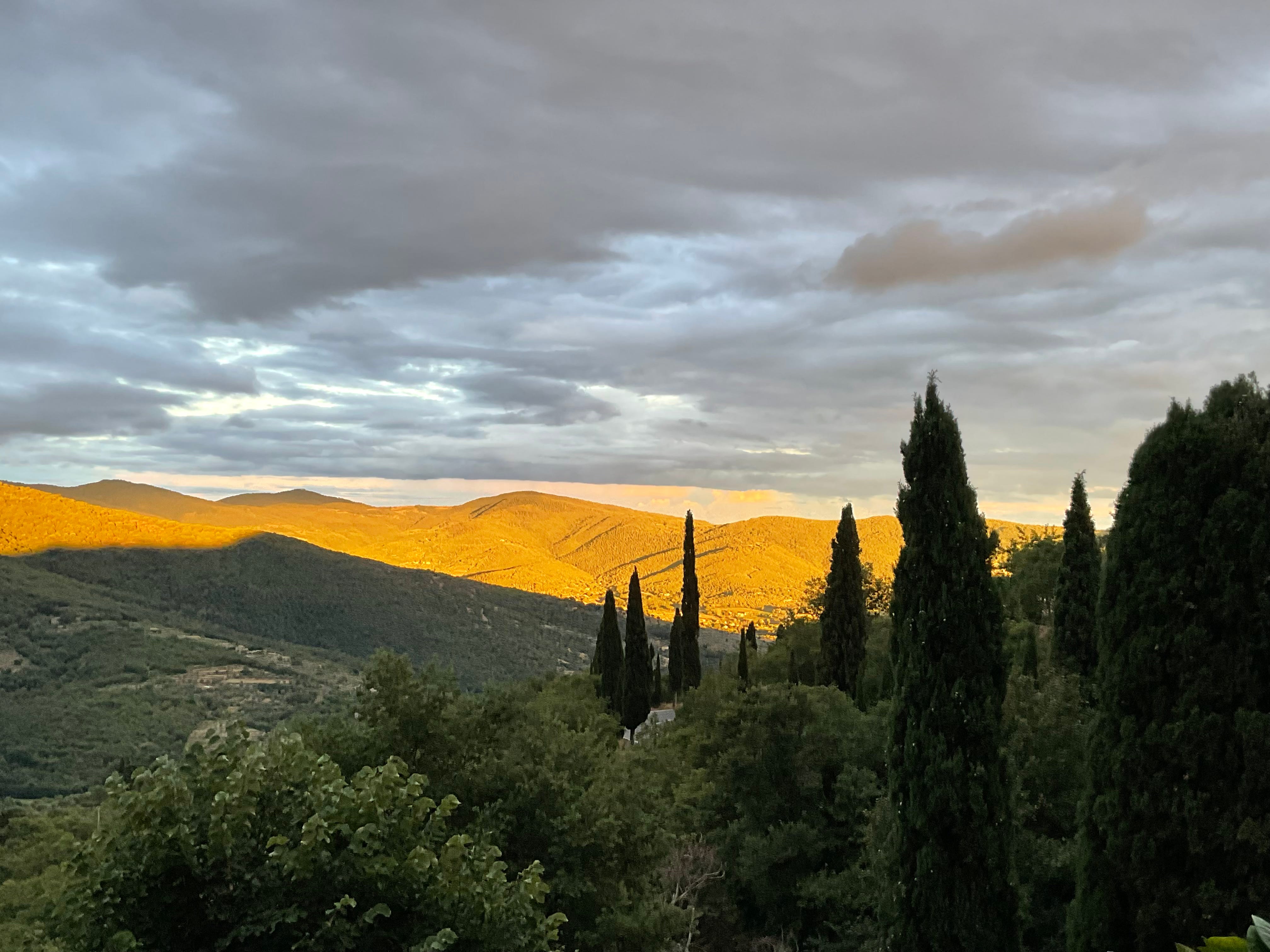
Since I’ve been writing on Substack, I’ve read dozens of posts about Americans leaving the US and taking up residency in a foreign country. Portugal seems to be most alluring because of its easier residency requirement, although that is changing now. France is always appealing, as is Spain. I’ve read too, about Sweden and Greece, and one about Thailand. The first clarion call that I remember was Kirsten Powers’s Substack post “How We Live in the US Is Not Normal,” where she describes the stresses, challenges, and exhaustion built into the expected working lives of Americans. The essay was not especially focused on the political perils in current life, but certainly mentioned staggering health care and education costs and the fears of parents for their children’s safety at school. Many of the posts I’ve read state those as the major relief of moving to a country with no-brainer gun regulations and free or affordable health care. A feeling of home does not include fear of dropping off kids at school or of not being able to get or pay for health insurance. For some, those are reason enough to go. Others want to go for the pleasures afforded by a new country, the opportunity to experience another culture, work interests, ease of travel, a clean break, or hundreds of other reasons. Some balk over leaving America at a perilous time, while others counter that you can still be active from abroad and, indeed, might have more energy for that than you might with a high-stress job at home.
Perhaps the desire to start over is more existential. As poet W.S Merwin wrote:
Send me out into another life
lord because this one is growing faint
I do not think it takes me all the way
Many exodus writers seem miffed at the bureaucracy of obtaining permits to stay in the new country—snafus, lost folders, changing regulations: trouble. Open borders would be grand, but they are not happening anywhere. (Try moving to the U.S.!) For those who can afford flat tax and Golden Visa options, Europe offers deals that balance out for some. For the rest, we must figure out our best options, get organized, and realize that, if we want to take such a drastic move, it’s a process. In Italy, residency happens step by step. A visa, obtained from the Italian embassy in the U.S., entitles you to apply for a permesso di soggiorno, permission to sojourn. Once you have that, you can get a fiscal code, something like a social security number, that enables you to open a bank account and buy property. If you continue to renew your permesso, you’re in line for legal residency, with identity card and health care. Italy, like other EU countries, also offers the coveted “digital nomad” visa for those with credentials. Without any permissions, you can stay in Europe for two separate ninety-day periods per year. No one used to care but now they do. The more you know the laws, the less frustrated you’ll be.
It’s fun to read of the excitement of arrival and settling in. Many feel euphoric, confused, excited, frustrated. My caution, in reading these posts, is that often the writer describes what happened to her as the way it is. Not so. Because you had this or that happen in Sicily or Valencia does not mean it will happen that way in Tuscany or Arles. Someone says you must have a lawyer to buy property. But here, where I am, that’s not so. You hear that you have to wait months for permits and licenses. Yes and no. (I got my passport in ten days.) Workers are unreliable. Workers are superb craftsmen—depends. If you’re reading about someone’s experience of grief or glory, that’s not going to be yours. Those explaining cultural differences after living in one place for five months, may be enjoying a big learning curve, but often they misinterpret an experience out of innocence. Often, I hear of angry misunderstandings. One person, incensed that she was asked not to touch the peaches, assumed the worst of the vegetable seller, when it’s actually an Italian law. Don’t touch! Besides, the fruitivendolo usually takes pride in selecting for you. In supermarkets, you don plastic gloves, bag and weigh your own produce. An American woman, who’d lived in Rome for many months, was outraged to get a sudden garbage bill for several hundred dollars, as were several of her friends. Well, garbage pick up is not free, and you must sign on for it when you move into a place. Not knowing that, she assumed she was being ripped off. Big learning curves ahead!
You’re a babe again, when you take up life in a place not your own. Many mistakes you make will become amusing stories you tell in later years.
What all the posts ignore is something I consider crucial. Before becoming a resident, you can drive with your American license. After becoming a resident, you have one year to obtain a driver’s license. (I think this is true in all the EU.) Having a rental car does not exempt you from the license requirement. At least the process gives you a long time to study! In Italy, the test is incredibly hard. They ask about tire sizes on trucks, cc’s of engines, first aid, and other highly technical exotica. You study 14,000 questions in Italian, and at the exam (also in Italian) you’re given 30 to answer. You can miss only three. And then there’s the road test. Without a license, you’ll have to live in a place served by bus and train and your own two feet. That is, no place of solitude in the country.
If you’re considering a move, my advice is to stay for a solid time in the place you’re considering. Go in winter when it’s not as glorious. It’s raining, and where is everyone? Study the language. If you don’t learn, you’re a forever ex pat. Meet people, get your hair cut, go to events, cook, check that you’re on a good train line, that the town is lively, and does the city offers solace and quiet as well as a fun buzz. Are the people friendly? Is there a vibrant cultural life? Walking trails? Shopping? Most of all, do you have that pulse-level response that tells you that you’re home?

Most interesting to me, of course, are the Substack posts of those who relocate to Italy. Having lived here a long time and written about every region of Italy, I can’t say I know it thoroughly—that would take four lifetimes. I can say that I appreciate down to the marrow the pleasures of Italian life. The daily pleasures.
My next post will be a laudatory list. Not that I’m trying to convert anyone. But maybe I’m suggesting that you first make your own list of the pleasures of where you live, an evaluation centering on what your choice of place gives you. Then launch, or not, your investigation of a possible leap of faith into another life.
Please come back next week, and meanwhile I’m starting my list.
Number 1: The nightingale’s chorus at 3 a.m. in May…
Note: My recent novel is just out in paper!

Thank you for this honest post! I think we all need to be reminded that what we see on social media usually doesn’t apply to real experiences-no matter where you live. I appreciate your balanced essay about the pros/cons of living abroad.
A timely piece, and a thoughtful one, thank you Frances. I read it from the perspective of one who immigrated to this country 45 years ago, and has lived here as a citizen for 40 of them. We already had green cards before we set foot here. In those days, if you had multiple graduate degrees from London University, native language ability in three languages including of course English, and deposited a certain sum in your name in a U.S. bank as a guarantee that you would not be a burden on society, the process was straightforward. We left our home country because we no longer wanted to live under an authoritarian regime, even if it meant leaving family, friends, and a comfortable lifestyle behind. America represented rights and liberties, particularly freedom of opinion. Today, at our age now, it’s ironic that we find ourselves fearing the future.