
Letto 28
Bed #28

This gorgeous Saturday morning, I am writing from one of the most sublime landscapes in the world—the hills around Montepulciano, where the vineyards are in full frisson of spring green.


But I didn’t come for the views, or the appealing restaurants in the centro, or the famous regional wines (Vino Nobile di Montepulciano is one of Tuscany’s tip-top wines). What landed me here is what travelers to foreign countries dread most—a medical emergency. I went to bed Monday night and soon began to have an ominous pain in my side. Awake all night, I dreaded telling Ed the next morning that something was definitely wrong. We had a dinner planned with good friends we hadn’t seen since we all decamped in the late fall. But when is it ever a good time to be struck down by the machinations of the body?
“It’s not nothing. This is intense,” I told him. We hurried to our doctor’s office and were lucky that her first appointment had not shown up. A manual exam only confirmed pain. She sent me to the emergency room at Nottola, the hospital outside Montepulciano, half an hour away. After EKG, X-rays, ultrasound, blood tests, CAT scan, I was diagnosed with acute appendicitis.
For 24 hours, they tried to control the problem with intravenous antibiotics, but on Wednesday it became clear that the infection was spreading like wildfire. I had surgery Wednesday night. They say laparoscopic surgery is easier than a single incision. But there are three small cuts, a camera inserted into your abdomen, gas pumped inside so they can use a light and see to insert other tools and extract the bothersome little appendix. Then a drainage tube is installed at the appendix location, exiting at one of the incisions. Your abdomen becomes a mixing bowl. All that activity stirring up your insides creates its own set of post-op pains.
Italy has one of the best-rated health care systems in the world. World Health Organization rank it #2, while USA is #37, among 191 countries. Life expectancy here is 84.1 years, and in USA 77. In all my years here, I’ve never had reason to experience the medical system. Now I have. Rather than recounting the post-op saga of drips and drainage, I want to describe the surprise of the workings and atmosphere of this large rural hospital in Tuscany. My time here only confirms that Italians are a different species.
From the beginning, I notice not a hushed aura but loud banter and laughter among the staff. Everyone talking, talking, talking. Wheeling me down the long halls to the next exam, my attendant regales me with risotto recipes. The diagnostic room lined with our gurneys has a single line of desks where doctors face a row of computers but also keep up a steady conversation. Various and constant entries from nurses and orderlies are greeted robustly. At first I found all this noise odd, but later, placed in a room with three others and experiencing a flotilla of nurses coming and going, I began to see that all the exuberance among them creates a space where poor you doesn’t feel gloom but only distraction and a let’s-do-this-team camaraderie. And how skilled they are at their jobs, with not a glum face among them.
This room, where I am in Bed 28, hosts four of those about to go to surgery or just returned for recovery. The wheeled bed is narrow and hard with a slab of a pillow. Although a luxury to have a lie-flat bed on a long flight, the similar comfort level is tough for days of recovery. No curtains surround, therefore there’s no privacy when, as it happened to me, you are given a bed bath, and there you lie spatchcocked for anyone to see. Even with averted eyes, I have seen the vulnerable bodies of quite a few people this week. A round of different doctors comes and goes, with your emergency surgeon unknown until the last minute. Groggy patients, on coming out of the anesthetic, immediately began talking among themselves. Loud. It’s in the culture to connect with the person next to you. Visiting hours can seem like a party. (But where’s the Vino Nobile di Montepulciano?) I see this socializing not only as the lively reassertion of normal life brimming up but also as the genetic disposition to chat up anyone who’s available.
Nevertheless, the voices are loud, they don’t suppress their phones’ fire-alarm rings, and their conversations go on into the night when the lights are finally out. As a southerner, I was highly socialized from the beginning, and I know the practice of not letting conversation falter into silence. “Rude,”my mother would say of a too-quiet guest, “born in a barn. Puts the onus on everyone else.” Even with my rigorous training, I find this cacophony shocking. I was profoundly irritated last night when a woman with dementia was brought in from leg surgery at bedtime and began a loud solo litany that continued through the wee hours. Not her fault, she should have a room alone, as the other three of us—all in stressful pain—didn’t sleep at all. She kept shouting for Mamma, for Maria, for Lucia, for Luigi, interspersed with loud moans and occasional shouts. This is a large public hospital, I kept telling myself, it’s packed, maybe they don’t have private rooms. As I’m writing, she sleeps placidly through the morning. I am not looking forward to her roaring awake.
Adjacent to her bed, another woman with a new knee lies moaning Dio, Mio Dio, Dio, Dio, a million times. The sound becomes a background noise, the cooing of a dove. When anyone enters, she revives and initiates bright conversation. Next to me, a young Muslim mother wraps different scarves around her head and chats with her children on the phone. The arabic is a lively musical language to hear. She too had appendicitis and is enduring the refusal of the staff to allow us food. Having read numerous articles online, I know this is not the practice in the USA, but I have had no food and only sips of water since the onset Monday night, five nights ago.
It is also not the practice in the USA to stay in the hospital for six days. Friends with hip replacement, breast surgery, broken pelvis, and other surgeries are out the door as soon as they can focus. Ed was in the car four hours after his gall bladder came out! But when I see how I am monitored and cared for and put on a five day antiobiotic drips, I don’t think at all that I should have been sent home. If I had, I would have had a terrible time getting to the bathroom. The incisions are draining via tubes into a bag that trails me on my hall walk. Not to say that the USA doesn’t have the best medical innovations that $$$ can buy and other virtues, of course. For those who can afford it.
The care is personal. They want to know about me, if I have children, where I live in the USA, where my house is, and why I like Italy. They call patients “amore,” love, or “cara,” dear, or '“tesoro,” treasure. What I’ve always known about Italy—that it is deeply humanistic—these days have confirmed.
Are all the surgeons like mine? He came in and took my hand when the decision to operate came down. As we chatted, I noticed his vintage Mont Blanc pen, just like one I have. We talked about writing with real ink and about books. He visits daily and always stays awhile. Last night, he gave me a kiss on my forehead and said that when I’m home he will come to Cortona on Tuesday to check on me. Ain’t happening in the USA!
Another cultural marker—in hospitals I have visited in the USA, meals are served on a tray at your bed. You eat alone. Here, in each of the surgical rooms, there’s a table and chairs!
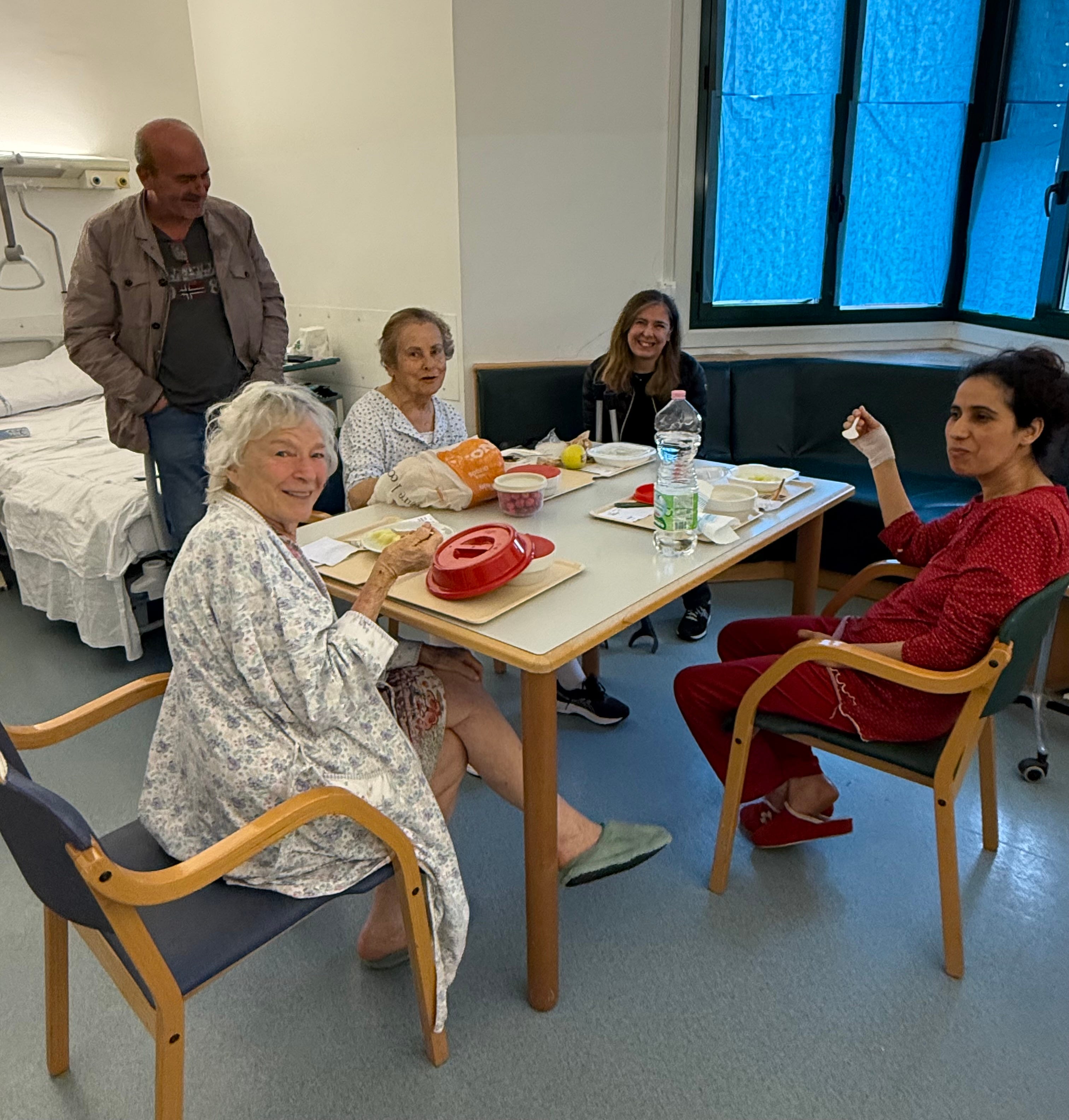
Relaltives have brought gnocchi, beef, and cherries to the patient left of me, while my other roommate and I feast on mashed potatoes. She was also allowed a bit of broth.Anyone who can manage drags their drips and sits down to eat and talk with others. This reminds me of what my neighbor Fiorella once told me. “It’s unhealthy to eat alone.” Not only that, but there’s that deep preference to be surrounded by others. DNA?
Would not wish this on anyone, especially a traveler, but it made me think about my travels in Cambodia, Viet Nam, North Africa, other parts of Europe. How scary for the body to flail in such a primal situation when you don’t speak the language. It moves me to realize that all of us leaving this hospital will pay nothing, not even for prescriptions. This is a country that has built birth-right healthcare for all into the constitution—Article 32. No one is burdened by insurance policies. Think of that.
This stint woke me to my Italian not being good with medical terminology, although it’s fine for everyday experience. Additional frustration. How amazing the Italian verve for life! Through all the stress and pain, I have been lucky. Monday—the ordeal began a week ago— I will be back with our two cats and with Ed, who has been making the drive every day. Although it’s one of the most beautiful roads in Tuscany, passing through the great vineyards of Poliziano and Avignonesi estates, it’s a daily grind driving over to visit and bring me chapstick and charging cords and eye drops. He’d love to be bringing gelato or cappuccino, but that’s not allowed. I can’t wait to go home. It’s planting time, party time, poppy time in Tuscany, and I will relish every moment. Carpe diem!
Hope that the travel gods always will be smiling on you. I’m going home.
Just had a similar if less momentous experience with a fractured ankle in Rome. Your piece beautifully captured my impression as well. There's a great deal of humanity in health care here-- both for better and worse.But it's good to be reminded that in the end, we're cured by people, not only medicines and procedures. Wishing you a good recovery.
Beautifully written and dear Frances, I love how you find the beauty in all of Italy, even the health care. We send love and healing thoughts. Hope you are home by now.